Introduction
Updating kitchen cabinets does not always mean replacing everything. You usually have three options: refinishing, refacing, or replacing.
Refinishing changes the surface finish. Refacing keeps the cabinet boxes but replaces visible surfaces. Replacing installs completely new cabinetry.
The right choice depends on your cabinet condition, budget, design goals, and kitchen layout. This guide compares all three options by cost, timeline, flexibility, and long-term value.
Refinish vs Reface vs Replace: Quick Comparison
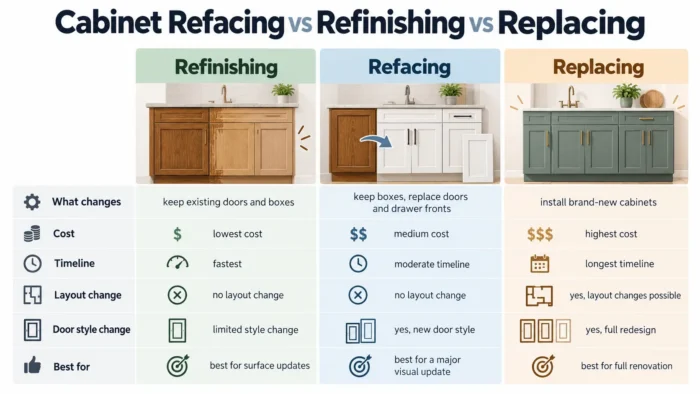
| Factor | Refinishing | Refacing | Replacing |
|---|---|---|---|
| Keep cabinet boxes | Yes | Yes | No |
| Keep existing doors | Usually yes | Usually no | No |
| Change cabinet color | Yes | Yes | Yes |
| Change door style | Limited | Yes | Yes |
| Change kitchen layout | No | No | Yes |
| Cost level | Lowest | Medium | Highest |
| Installation disruption | Low | Moderate | High |
| Best for | Cosmetic updates | Major style updates | Full renovations |
What Is Cabinet Refinishing?
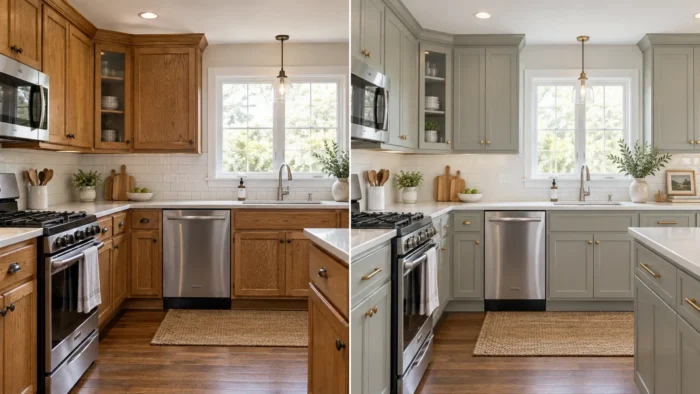
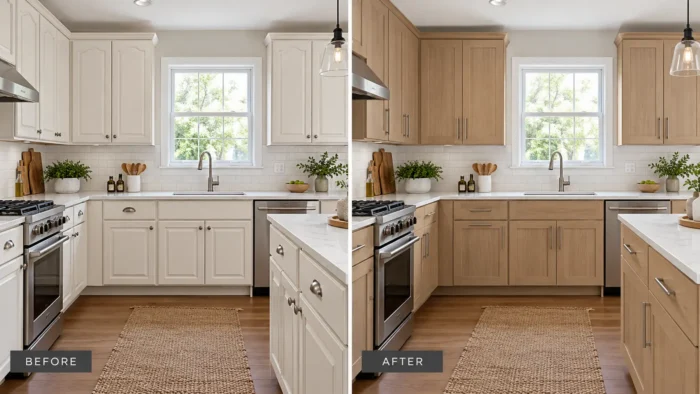
Cabinet refinishing keeps your existing cabinet boxes, doors, and drawer fronts.
The existing finish is cleaned, prepared, sanded, and then repainted or restained.
Refinishing works best when your cabinetry is structurally sound and you still like the existing door style.
It is mainly a cosmetic update.
What Does Cabinet Refinishing Include?
A typical refinishing project may involve:
- Removing doors and hardware
- Cleaning cabinet surfaces
- Repairing small defects
- Sanding or deglossing the finish
- Applying primer where needed
- Painting, staining, or clear coating
- Reinstalling doors and hardware
The exact process depends on the cabinet material and existing finish.
When Should You Refinish Cabinets?
Refinishing may be a good option when:
- Cabinet boxes are still strong
- Doors are in good condition
- You like the current kitchen layout
- You only want a new color or finish
- Your budget is limited
- There is no major water or structural damage
Advantages of Cabinet Refinishing
- Usually the lowest-cost option
- Keeps most existing materials
- Creates less renovation waste
- Causes less disruption
- Can dramatically change cabinet color
Limitations of Cabinet Refinishing
- Cannot change the kitchen layout
- Cannot significantly change door profiles
- Does not solve damaged cabinet boxes
- Surface preparation can be labor-intensive
- Some materials require specialized preparation
Suitability depends on the substrate and existing finish.
Solid wood performs well with staining. Painted finishes can work on several prepared surfaces.
What Is Cabinet Refacing?
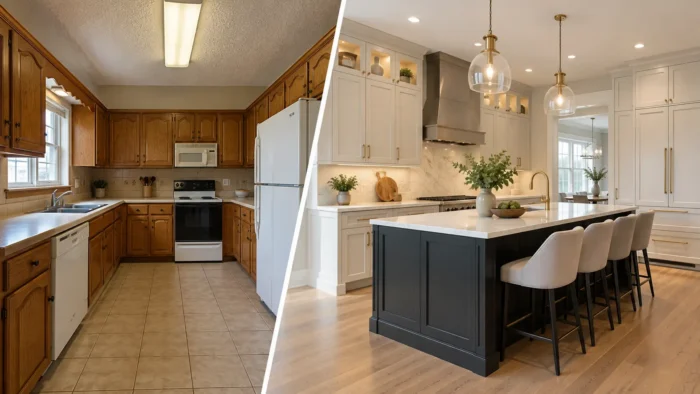
Cabinet refacing keeps the existing cabinet boxes.
However, the doors and drawer fronts are usually replaced.
The visible surfaces of the cabinet boxes are also covered with new veneer, laminate, or another finish material.
This creates a much larger visual transformation than refinishing.
Angi describes refacing as replacing doors and drawer fronts while applying new veneer to existing cabinet surfaces.
What Does Cabinet Refacing Include?
A typical project may include:
- Removing existing doors
- Removing drawer fronts
- Preparing cabinet boxes
- Applying veneer or laminate
- Installing new doors
- Installing new drawer fronts
- Replacing hinges and hardware
- Making final alignment adjustments
When Should You Reface Cabinets?
Refacing is usually suitable when:
- Cabinet boxes remain structurally sound
- You like the existing kitchen layout
- You want a new door style
- You want a major visual change
- Full replacement is unnecessary
- You want less disruption than a full remodel
Advantages of Cabinet Refacing
- Changes the cabinet style significantly
- Costs less than many full replacements
- Reuses existing cabinet boxes
- Produces less construction waste
- Usually requires less disruption
Limitations of Cabinet Refacing
- Cannot correct a poor kitchen layout
- Cannot fix badly damaged cabinet boxes
- Interior cabinet dimensions stay unchanged
- Premium doors and veneers can increase costs
- Custom work can reduce the cost difference versus replacement
What Does Cabinet Replacement Involve?
Cabinet replacement removes the existing cabinetry and installs new cabinet boxes, doors, drawers, and hardware.
This is the most comprehensive option.
It also provides the greatest design freedom.
You can change:
- Kitchen layout
- Cabinet dimensions
- Storage configuration
- Door styles
- Materials
- Hardware
- Cabinet heights
- Appliance locations
- Island design
- Internal accessories
Replacement is usually the best choice when your existing cabinets have structural problems.
It is also better when you want a completely different kitchen layout.
When Should You Replace Cabinets?
Consider replacement when:
- Cabinet boxes are damaged
- Panels are swollen from moisture
- Mold or severe deterioration is present
- Existing storage is insufficient
- The layout does not work
- You want new cabinet dimensions
- You are completing a full kitchen renovation
- Existing cabinets cannot support your desired design
Replacement costs more, but it provides significantly greater customization.
Angi notes that full replacement allows homeowners to redesign storage and kitchen layout.
How to Choose Between Refinishing, Refacing, and Replacing
Use this simple decision process.
Step 1: Are the Cabinet Boxes Structurally Sound?
No: Replace the cabinets.
Yes: Continue.
Step 2: Do You Want to Change the Kitchen Layout?
Yes: Replace the cabinets.
No: Continue.
Step 3: Do You Want a New Cabinet Door Style?
Yes: Consider refacing.
No: Consider refinishing.
Step 4: Do You Only Want a New Color or Finish?
If yes, refinishing is usually the most practical option.
This decision process helps avoid paying for more work than necessary.
When New Custom Cabinets Make More Sense
Refacing and refinishing work well for cosmetic updates. However, new custom cabinets offer more flexibility.
Custom replacement makes sense when you need:
- Better storage efficiency
- Nonstandard dimensions
- New kitchen layouts
- Integrated appliances
- Custom finishes
- Specialized internal accessories
- Full-height cabinetry
- Improved material quality
For major renovations, replacement can provide better long-term value.
Why Choose PA Kitchen for Custom Cabinet Replacement?
PA Kitchen provides custom cabinetry for residential and commercial projects.
Our services support homeowners, developers, contractors, designers, and distributors.
PA Kitchen offers:
- Custom cabinet dimensions
- Multiple cabinet materials
- Custom colors and finishes
- 2D and 3D design support
- Kitchen cabinets
- Wardrobes
- Bathroom vanities
- Whole-house cabinetry
- Factory-direct manufacturing
- International project support
For projects where refacing is no longer practical, custom replacement provides greater flexibility.
It allows you to redesign the kitchen around your actual storage and lifestyle needs.
Planning a full kitchen cabinet replacement? Contact PA Kitchen to discuss your dimensions, finishes, drawings, quantities, and project requirements.
Conclusion
Refinishing, refacing, and replacing can all improve an outdated kitchen. The right option depends on what you want to change.
Choose refinishing when your cabinets only need a surface update. Choose refacing when the cabinet boxes remain good but you want new doors and visible finishes. Choose replacement when the boxes are damaged or the kitchen layout needs major improvement.
Before deciding, evaluate cabinet condition, budget, timeline, and long-term design goals. A careful comparison can help you avoid unnecessary costs while achieving the kitchen you want.
FAQs
1. Is it cheaper to reface or replace kitchen cabinets?
Refacing is usually cheaper because the existing cabinet boxes remain in place. Full replacement requires new cabinets, more labor, and often additional installation work.
2. Is cabinet refacing worth it?
Yes, if the cabinet boxes are structurally sound and the current layout works well. Refacing can provide a major visual update without the cost of complete replacement.
3. Should I reface or refinish my kitchen cabinets?
Choose refinishing if you only want a new color or surface finish. Choose refacing if you want new cabinet doors and a more noticeable style change.
4. Can you change the kitchen layout when refacing cabinets?
Usually not. Refacing keeps the existing cabinet boxes in their current positions. If you want a new layout, full cabinet replacement is usually the better option.
5. When should kitchen cabinets be completely replaced?
Replacement is usually best when cabinet boxes are damaged, storage is insufficient, or the kitchen layout no longer meets your needs.