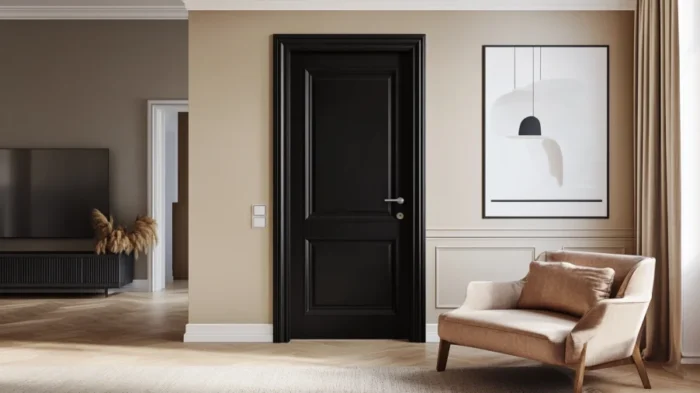
Choosing hotel room doors sounds simple, right?
You pick a design, confirm the size, place the order, and install them.
But in a real hotel project, it is not that simple.
Hotel room doors are not just decorative interior doors. They affect fire safety, guest privacy, sound insulation, daily durability, maintenance costs, and even the guest’s first impression of the room. For hotel owners, developers, contractors, architects, and procurement teams, the right hotel room doors can make the project smoother. The wrong ones can create delays, complaints, and extra costs.
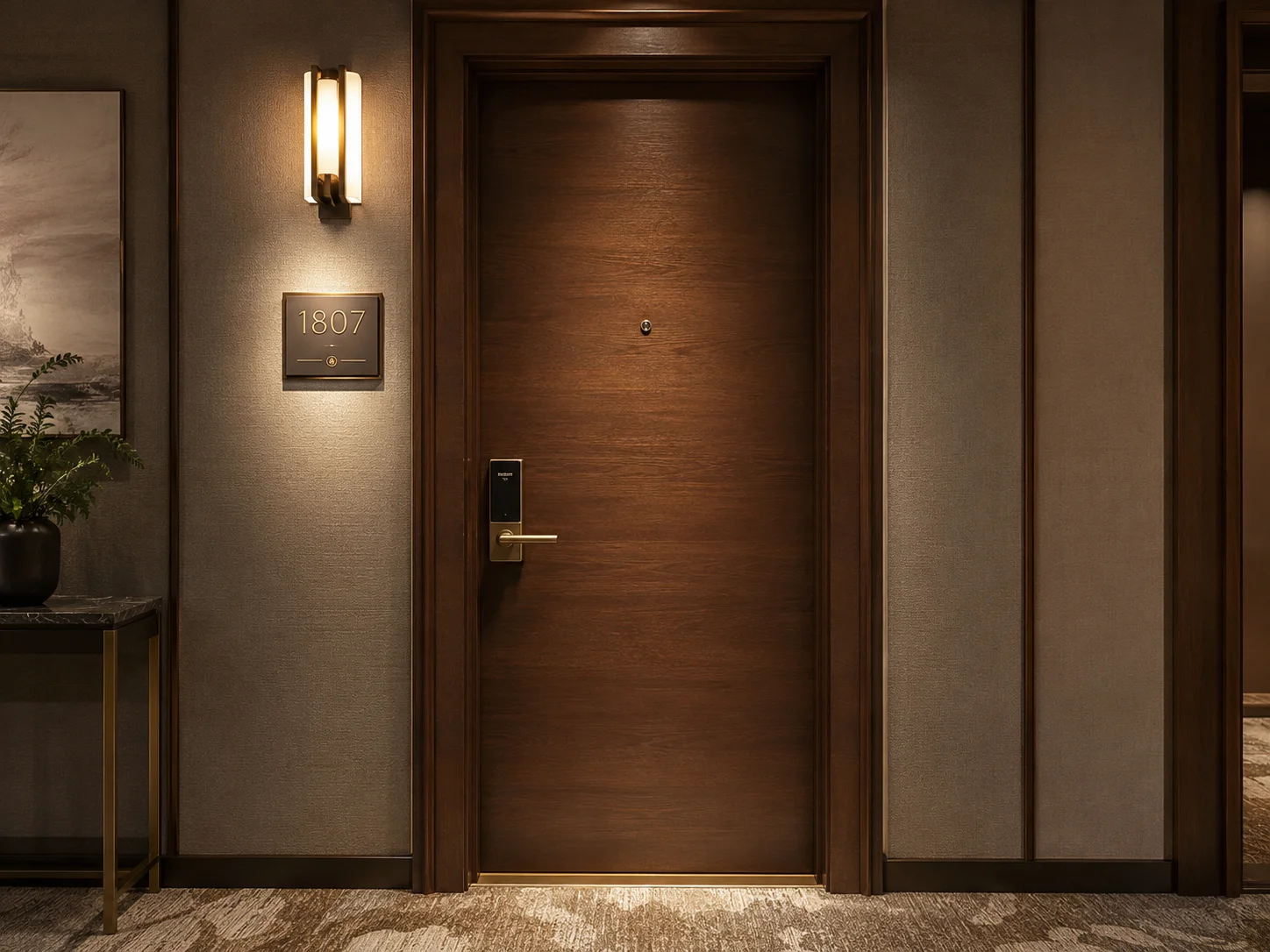
In this guide, “hotel room doors” mainly refer to guest room entrance doors installed between hotel corridors and guest rooms. These are the doors your guests see, touch, hear, and use every day.
Let’s look at how to choose the right hotel room doors for your hotel project.
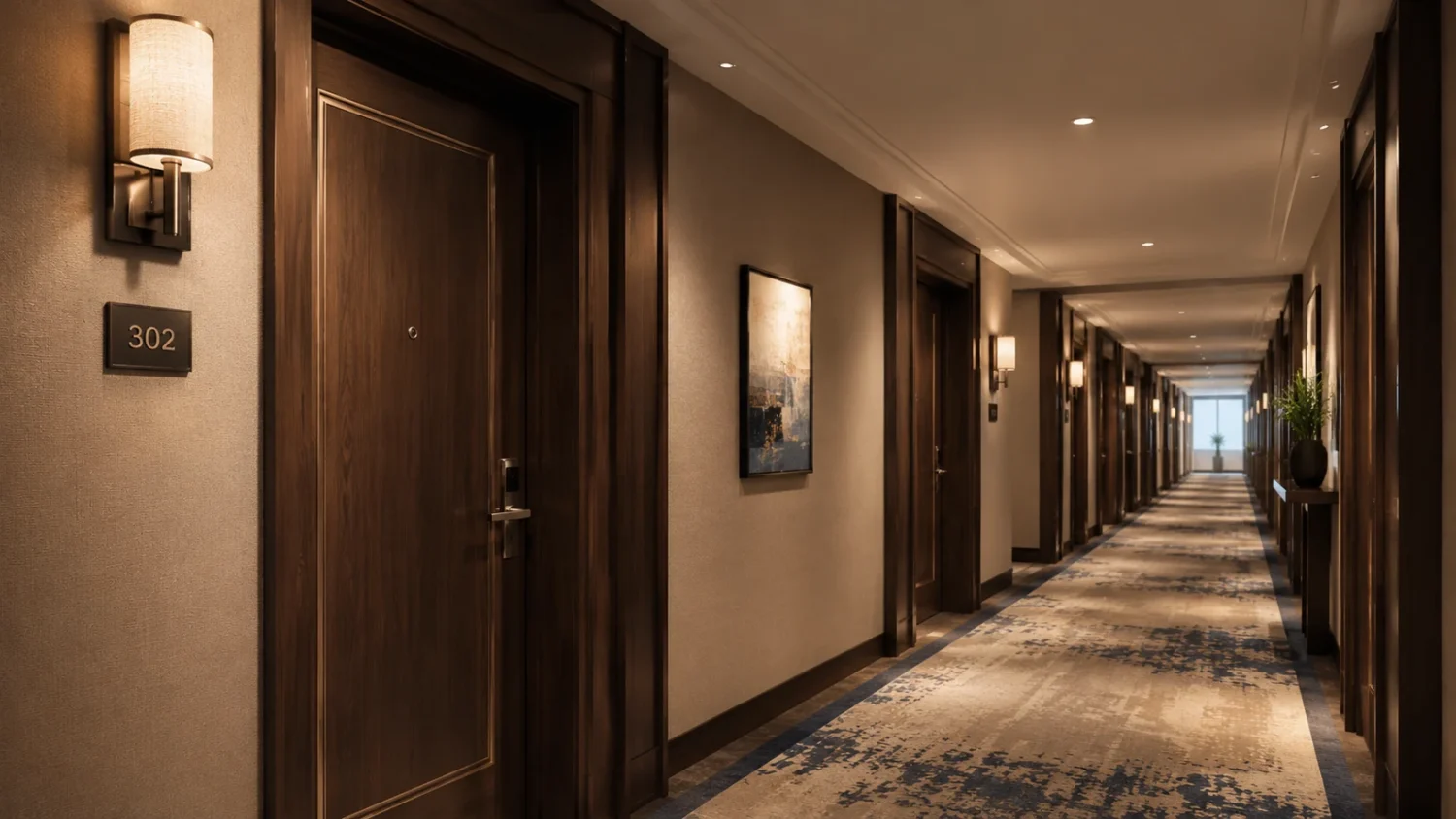
Why Are Hotel Room Doors Important for Hotel Projects?
A hotel room door is like the handshake before the guest enters the room. It gives the first feeling of safety, privacy, and quality.
But beyond appearance, it also carries serious project responsibilities.
Hotel Room Doors Affect Safety and Compliance
In many hotel projects, guest room entrance doors need to meet local fire safety and building code requirements. Fire-rated doors are often used to help slow the spread of fire and smoke, especially between corridors and guest rooms.
In North America, fire door assemblies are commonly tested and classified as complete assemblies, not just as individual door leaves. UL notes that fire door assemblies may include the door, frame, glazing, hardware, and accessories, and fire-protection ratings can range from 20 or 30 minutes to several hours depending on the application.
NFPA also states that fire doors should be inspected and tested after initial installation and at least annually after that, which shows how important ongoing fire door performance is in building safety.
Guest Room Doors Influence Privacy and Comfort
Guests may not notice a good door.
But they will notice a bad one.
If they hear people talking in the corridor, luggage wheels rolling past, housekeeping carts moving, or doors slamming nearby, their sleep quality suffers. Research on hotel guest sleep found that sound-related factors, including room noise, can affect sleep satisfaction.
That is why soundproof hotel room doors are not just a luxury feature. They are part of the guest experience.
Poor Door Selection Can Increase Project Costs
A cheap or poorly specified hotel room door can become expensive later.
Common problems include:
- Failed inspection because of incorrect fire rating
- Poor sound insulation and guest complaints
- Surface scratches after short use
- Wrong size or frame depth
- Delayed installation
- Inconsistent color between batches
- Higher repair and replacement costs
In hotel projects, a door is not just a product. It is part of the whole operation.
What Should You Confirm Before Choosing Hotel Room Doors?
Before comparing materials, finishes, and prices, take a step back.
What does your project really need?
Many buyers make the mistake of asking for a quotation too early. But without clear project requirements, every supplier may quote a different door. Then price comparison becomes meaningless.
What Type of Hotel Project Are You Working On?
Different hotels need different hotel room doors.
| Project Type | Key Door Priorities |
|---|---|
| New hotel construction | Design consistency, bulk production, fire rating, delivery schedule |
| Hotel renovation | Existing openings, fast installation, phased delivery |
| Budget hotel | Cost control, durability, standard finishes |
| Business hotel | Fire safety, acoustic performance, clean design |
| Boutique hotel | Custom design, brand style, premium finish |
| Luxury hotel | High sound insulation, refined finish, premium appearance |
For example, a budget hotel may care most about cost control and easy maintenance. A luxury hotel may need premium veneer, better acoustic performance, and custom details. A renovation project may focus on matching existing openings and reducing installation time.
So the first question is not “Which door is cheapest?”
The better question is: Which hotel room door fits this project best?
What Are the Project Requirements?
Before choosing hotel room doors, confirm these points:
- Hotel category
- Number of rooms
- Room types
- Required fire rating
- Acoustic requirements
- Door size
- Wall thickness
- Door finish
- Budget range
- Delivery timeline
- Sample room approval process
Also, check whether your project needs accessible room doors. In the United States, ADA guidance states that accessible doors should provide at least 32 inches of clear width, measured with the door open 90 degrees.
Even if your project is outside the U.S., this is a good reminder: door size is not only about appearance. It also affects accessibility, safety, and daily use.
What Fire Rating Do Hotel Room Doors Need?
Fire rating is one of the most important factors when choosing hotel room doors.
Why? Because hotel guest rooms are private spaces connected to public corridors. In an emergency, every minute matters.
Choose the Right Fire Rating
Common fire-rated hotel room door options may include:
- 30-minute fire-rated doors
- 45-minute fire-rated doors
- 60-minute fire-rated doors
- 90-minute fire-rated doors
In some regions, ratings may also be expressed differently, such as 20 minutes, ¾ hour, 1 hour, or 1½ hours. UL lists several common fire-protection ratings for doors, including 20 minutes, 30 minutes, ¾ hour, 1 hour, 1½ hours, 3 hours, and 4 hours.
The safest approach is simple:
Confirm the required fire rating before production.
Ask your architect, contractor, fire consultant, or local authority. Then make sure your hotel door supplier can provide the correct certificates or test reports.
Parts of a Fire-Rated Door Should Be Checked
A fire-rated hotel room door is not only a door slab.
Related parts may include:
- Fire-rated door leaf
- Fire-rated door frame
- Intumescent strips
- Smoke seals
- Fire-rated hinges
- Fire-rated lock
- Door closer
- Threshold or drop seal
Think of it like a chain. If one link is weak, the whole chain becomes weaker.
A fire-rated door leaf with the wrong frame or hardware may not perform as expected. That is why project teams should check the full specification, not just the door surface.
How Can Hotel Room Doors Improve Sound Insulation?
After safety, sound insulation is one of the biggest concerns for hotel room doors.
Nobody books a hotel room to hear every conversation in the corridor.
What Affects the Acoustic Performance of Hotel Room Doors?
Sound insulation does not depend on one single factor.
It depends on the whole opening condition, including:
- Solid core structure
- Door thickness
- Door weight
- Perimeter seals
- Drop-down seal
- Frame installation
- Gap control
- Threshold design
STC, or Sound Transmission Class, is commonly used to describe how well a building element blocks airborne sound. It is a single-number rating based on laboratory testing, often connected with ASTM E90 and ASTM E413 methods.
But here is the practical point: even a high-performance door can lose sound insulation if there are large gaps around it.
Sound is like water. It finds the small cracks.
That is why sealing, installation, and gap control matter so much.
How Much Sound Insulation Do Different Hotels Need?
Not every hotel needs the same acoustic performance.
| Hotel Type | Acoustic Requirement |
|---|---|
| Economy hotel | Basic corridor noise reduction |
| Mid-scale hotel | Better privacy and comfort |
| Business hotel | Stable acoustic performance for frequent guests |
| Boutique hotel | Enhanced privacy and atmosphere |
| Luxury hotel | Higher acoustic performance and premium sealing system |
For most hotel projects, a solid core hotel room door with good perimeter seals offers a practical balance between performance and cost.
For premium hotels, consider stronger acoustic construction, better sealing systems, and stricter installation control.
What Material is Best for Hotel Room Doors?
There is no single “best” material for every hotel.
The best hotel room door material depends on your project budget, fire rating, acoustic needs, design style, and maintenance expectations.
What Are the Common Materials for Hotel Room Doors?
Common hotel room door materials include:
- Solid wood doors
- Engineered wood doors
- Composite wood doors
- Fire-rated wooden doors
- Steel doors
- Laminate doors
For guest room entrances, wooden and engineered wood doors are widely used because they balance appearance, customization, and performance.
Steel doors are strong, but they are more commonly used in service areas, utility rooms, staircases, and back-of-house spaces rather than guest room entrances.

How Do Wooden Hotel Room Doors Perform?
Wooden hotel room doors are popular because they look warm and welcoming.
They can match many interior styles, from modern business hotels to boutique resorts. They can also be finished with veneer, laminate, paint, or custom decorative details.
Best for:
- Guest rooms
- Suites
- Boutique hotels
- Business hotels
- Luxury hotels
However, solid wood is not always the most stable choice for every climate. Depending on humidity and temperature, natural wood may expand or shrink. That is why many hotel projects use engineered wood or composite wood structures for better stability.
Compare Hotel Room Door Materials
| Material | Advantages | Best For |
|---|---|---|
| Solid wood | Premium appearance, strong texture | Luxury hotels, suites |
| Engineered wood | Stable, cost-effective, design flexible | Mid-scale and business hotels |
| Composite wood | Flexible performance and cost control | Custom hotel projects |
| Fire-rated wooden door | Safety, compliance, hotel-friendly appearance | Guest room entrances |
| Steel door | Strong and secure | Service areas, back-of-house areas |
| Laminate door | Durable, easy to clean, cost-effective | Chain hotels, high-traffic projects |
How Do You Choose the Right Size for Hotel Room Doors?
Common Hotel Room Door Dimensions
Hotel room door dimensions vary by country, building code, project design, wall structure, and hotel positioning.
Important dimensions include:
- Door width
- Door height
- Door thickness
- Clear opening width
- Wall thickness
- Frame depth
For accessible rooms, always check local accessibility standards. As mentioned earlier, ADA guidance requires at least 32 inches of clear opening width for accessible doors in the U.S.
Do not simply copy dimensions from another project. A hotel in Dubai, London, New York, or Singapore may follow different requirements.
When Do You Need Custom Hotel Room Doors?
Custom hotel room doors may be needed for:
- Extra-height rooms
- Luxury suites
- Accessible rooms
- Renovation projects
- Different wall thicknesses
- Special door frame designs
- Custom project requirements
Renovation projects need extra care. Existing openings may not be consistent. Walls may not be straight. Floor levels may change after new finishes are installed.
That is why site measurement is critical before mass production.

Conclusion
Choosing hotel room doors for a hotel project is not just about selecting a design or material.
A good hotel room door should meet fire safety requirements, improve sound insulation, protect guest privacy, withstand daily use, match the hotel’s interior design, and support smooth project delivery.
For hotel owners, developers, contractors, and procurement teams, the best choice is not always the cheapest door. It is the door solution that offers the right balance of safety, durability, appearance, performance, and long-term value.
So before placing an order, ask the right questions.
What fire rating does the project need?
What level of sound insulation is expected?
Which material and finish fit the hotel positioning?
Are the sizes and samples confirmed?
Can the supplier support the full project timeline?
When these answers are clear, choosing hotel room doors becomes much easier.
And your hotel project becomes much safer, smoother, and more successful.
FAQs
Most hotel rooms use solid core or fire-rated wooden doors because they offer a good balance of safety, sound insulation, durability, and design flexibility. For guest room entrances, hotel room doors should usually be stronger and heavier than standard residential interior doors. They may also need fire-rated frames, smoke seals, acoustic seals, and compatible hardware depending on local building codes and project requirements. Fire door assemblies are usually evaluated as complete systems, including the door, frame, hardware, and accessories.
Yes, in many hotel projects, hotel room doors need to be fire-rated, especially when they are installed between guest rooms and corridors. The required fire rating depends on local building codes, project drawings, wall ratings, and fire safety requirements. Common options include 30-minute, 45-minute, 60-minute, and 90-minute fire-rated doors. Always confirm the required rating with the architect, contractor, or local authority before production.
The best material for hotel room doors is usually engineered wood, solid core wood, or fire-rated wooden construction. These materials are widely used because they can provide good stability, acoustic performance, fire safety options, and attractive finishes. For most hotel guest room entrances, fire-rated wooden hotel room doors with veneer, HPL, laminate, or painted finishes are practical choices. Steel doors are stronger, but they are more commonly used for service areas or back-of-house spaces.