What Are Italian Kitchen Cabinets?
Italian kitchen cabinets generally refer to cabinetry influenced by Italian kitchen design traditions, known for their clean lines, sophisticated finishes, innovative storage, and attention to detail. They often combine contemporary aesthetics with practical functionality, creating kitchens that feel both elegant and comfortable.
It is important to distinguish between Italian-style kitchen cabinets and cabinets manufactured in Italy. Italian-style cabinetry follows the design principles associated with Italian kitchens, while Made-in-Italy cabinets are products manufactured in Italy. A kitchen can incorporate Italian design elements without every component being sourced from an Italian manufacturer.
Key Features of Italian Kitchen Cabinets
What makes Italian kitchen cabinets stand out is the way they combine visual simplicity with practical details. Several design features contribute to their popularity in contemporary residential projects.
Minimalist and Handleless Designs
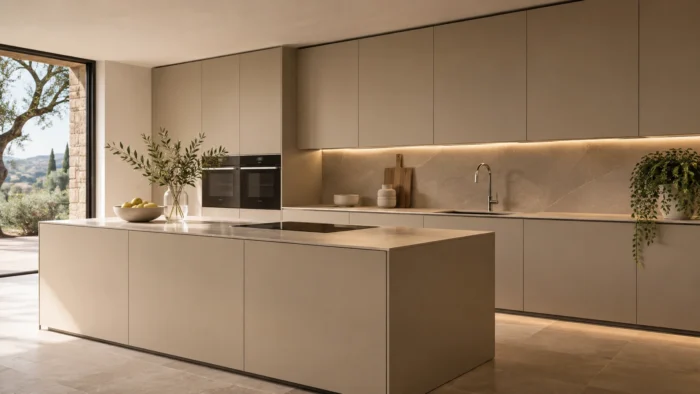
Handleless cabinetry is one of the most recognizable features of modern Italian kitchen design. By reducing visible hardware, it creates continuous cabinet surfaces and a clean, architectural appearance.
Common handleless solutions include:
J-pull and integrated finger-pull profiles
Recessed aluminum handles
Push-to-open mechanisms
Continuous gola handle systems
These options work particularly well with flat-panel cabinet doors and matte or high-gloss finishes. However, the choice of opening system should also consider ease of use, maintenance, and long-term hardware performance.
Seamless Storage and Integrated Appliances

Italian kitchen cabinets often use concealed storage and integrated appliances to maintain a consistent visual appearance.
Tall cabinets can accommodate built-in refrigerators, ovens, and pantry storage, while deep drawers provide organized space for cookware, utensils, and kitchen accessories.
Corner pull-out systems, internal drawer organizers, and concealed waste bins can also improve storage efficiency without adding visual clutter.
For smaller kitchens, these solutions are especially useful because they help maximize available space while maintaining a streamlined design.
Premium Materials and Refined Finishes

Material selection plays an important role in Italian kitchen aesthetics. Rather than relying on elaborate decoration, designers often combine different textures and finishes to create visual contrast.
Popular combinations include:
Natural wood veneer with matte white cabinets
Dark lacquered cabinets with marble-effect countertops
Warm oak finishes with brushed metal hardware
Neutral matte cabinets with textured stone surfaces
The key is to balance colors, materials, and surface textures so that the kitchen feels cohesive rather than overly complicated.
Open-Plan Kitchen and Living Integration

Modern Italian kitchen design frequently treats the kitchen as an extension of the living area.
Kitchen islands, peninsula counters, integrated dining spaces, and coordinated cabinetry help connect cooking and social areas. Cabinet finishes may also be matched with wall panels, shelving, and living room storage to create a consistent interior style.
This approach is particularly suitable for open-plan apartments and contemporary villas where the kitchen is an important part of the overall living environment.
Popular Italian Kitchen Cabinet Styles
Italian kitchen cabinets are available in a variety of styles, ranging from understated contemporary designs to more luxurious and expressive interiors.
Modern Italian Kitchen Cabinets

Modern Italian kitchen cabinets focus on clean lines, practical layouts, and carefully coordinated finishes. Flat-panel doors, integrated appliances, and minimalist hardware are commonly used to achieve a contemporary appearance.
Neutral colors such as white, beige, grey, and black are popular choices. Wood accents and stone countertops can add warmth and texture without compromising the overall simplicity.
Contemporary Luxury Italian Kitchen Cabinets

Luxury Italian kitchen cabinets often combine premium-looking surfaces, sophisticated hardware, and carefully planned lighting.
Common design elements include large kitchen islands, marble or quartz-effect countertops, metallic details, and full-height cabinetry. Dark wood, deep grey, warm beige, and dramatic stone patterns can create a more distinctive appearance.
These designs are particularly suitable for high-end villas, luxury apartments, and premium residential developments.
Italian Wood Kitchen Cabinets

Wood is an important material in many Italian-inspired kitchens. Natural oak, walnut, and wood veneer finishes introduce warmth and texture, balancing the clean lines of modern cabinetry.
Wood cabinets can be used throughout the kitchen or combined with painted cabinet doors to create a two-tone design.
For example, walnut lower cabinets paired with light beige upper cabinets can create a balanced look that feels modern without appearing too cold.
Minimalist Italian Kitchen Cabinets

Minimalist Italian kitchen cabinets emphasize simplicity in both appearance and layout.
They typically feature handleless doors, concealed appliances, integrated storage, and a restrained color palette. Decorative elements are kept to a minimum, allowing the quality of materials and proportions to become the main focus.
This style is a practical choice for homeowners who prefer a clean, uncluttered kitchen that remains visually appealing over time.
Materials and Finishes for Italian Kitchen Cabinets
| Material / Finish | Key Features | Benefits | Considerations |
|---|---|---|---|
| Wood Veneer | Natural wood surface with oak, walnut, or ash textures | Provides a warm, natural appearance | Requires proper surface protection and maintenance |
| Solid Wood | Natural wood construction with unique grain patterns | Durable and timeless aesthetic | More sensitive to humidity and temperature changes |
| Matte & High-Gloss Lacquer | Smooth surfaces with various color options | Offers a refined, modern appearance | Glossy finishes may show fingerprints and scratches |
| PET & Acrylic | Modern decorative surfaces with consistent finishes | Available in various colors and textures; easy to maintain depending on product specifications | Scratch resistance and edge quality vary by product |
| Melamine & Laminates | Decorative surfaces with different patterns and textures | Cost-effective and practical for everyday use | Appearance and durability depend on product quality |
Popular Countertop Materials
Italian-inspired kitchens often combine cabinetry with stone countertops to create a cohesive and sophisticated look.
| Countertop Material | Key Features | Main Advantages |
|---|---|---|
| Natural Marble | Distinctive veining and natural patterns | Elegant appearance and unique textures |
| Engineered Quartz | Consistent colors and patterns | Non-porous surface and relatively easy maintenance |
| Sintered Stone | Manufactured using mineral materials under high pressure and heat | Good heat, scratch, and stain resistance, depending on the product |
| Porcelain | Available in various colors and stone-inspired patterns | Low porosity and easy cleaning |
When choosing materials, consider your design preferences, budget, maintenance requirements, and expected daily use. Combining different finishes can also create a balanced kitchen design without compromising functionality.
How Much Do Italian Kitchen Cabinets Cost?
The cost of Italian kitchen cabinets varies considerably depending on the manufacturer, materials, cabinet dimensions, hardware, customization requirements, and installation location.
There is no single price that applies to all Italian-style kitchens. A modular kitchen with laminate finishes will generally have a different budget from a fully customized kitchen featuring natural wood veneer, premium hardware, and stone countertops.
Custom vs. Modular Kitchen Cabinets
Custom and modular cabinetry serve different project requirements.
Modular kitchen cabinets use standardized dimensions and components, making them suitable for projects that prioritize predictable layouts, shorter production processes, and budget control.
Custom kitchen cabinets are designed around specific room dimensions and customer requirements. They offer greater flexibility in cabinet sizes, materials, finishes, and storage configurations.
For unusual layouts, luxury villas, and large residential projects, customized cabinetry may provide better design flexibility. For standard apartment layouts or budget-conscious renovations, modular solutions can be a practical alternative.
Ways to Balance Design and Budget
You do not need to use premium materials for every cabinet to achieve an elegant Italian-inspired kitchen.
Consider using more distinctive finishes on visible areas, such as kitchen islands or feature cabinets, while selecting practical laminates for less prominent storage areas.
Other ways to manage costs include:
Choose a consistent range of cabinet finishes.
Prioritize durable hardware for frequently used drawers and doors.
Use standard cabinet dimensions where possible.
Compare quotations based on the same specifications.
Consider the long-term maintenance requirements of different materials.
A detailed specification is essential when comparing suppliers because two kitchens with similar appearances may have very different internal constructions and hardware.
Italian Kitchen Cabinets vs. Other Kitchen Styles
Italian, German, and American kitchen cabinets are often compared when buyers are exploring different kitchen design approaches. However, these categories are broad design and market references rather than fixed manufacturing standards. Individual brands and product ranges can differ considerably.
| Comparison | Italian Kitchen Cabinets | German Kitchen Cabinets | American Kitchen Cabinets |
|---|---|---|---|
| Design Focus | Contemporary aesthetics and material combinations | Precision, functionality, and systematic planning | Traditional and transitional design options |
| Common Styles | Minimalist, handleless, luxury | Modern, streamlined, ergonomic | Shaker, framed, contemporary |
| Cabinet Finishes | Lacquer, wood veneer, matte surfaces | Laminates, lacquer, textured finishes | Painted wood, veneer, laminate |
| Storage | Integrated and concealed systems | Highly organized modular systems | Broad range of storage configurations |
| Customization | Varies by manufacturer | Varies by manufacturer | Varies by manufacturer |
| Suitable Projects | Modern homes and luxury interiors | Contemporary residential projects | Traditional and modern homes |
The best option depends on the intended design, budget, available space, and supplier capabilities. Buyers should evaluate individual cabinet specifications rather than assuming that all products from one country share the same construction quality or performance.
How to Choose the Right Italian Kitchen Cabinets
Choosing the right Italian kitchen cabinets requires balancing appearance, functionality, durability, and budget. Before selecting a supplier, consider the following factors.
Consider Your Kitchen Layout and Design
Choose cabinet styles and configurations that suit your kitchen dimensions and overall interior design. Consider storage space, appliance placement, and workflow to ensure the kitchen is both attractive and practical.
Evaluate Materials, Hardware, and Quality
Check cabinet materials, surface finishes, hinges, drawer systems, and construction details. Prioritize moisture resistance, durability, and ease of maintenance to ensure long-term performance.
Choose a Reliable Cabinet Manufacturer
Compare manufacturers based on customization capabilities, production quality, project experience, and after-sales support. For large residential or commercial projects, also consider production capacity, delivery schedules, and installation services.
FAQs about Italian Kitchen Cabinets
1. What Makes Italian Kitchen Cabinets Different?
Italian kitchen cabinets are known for their streamlined designs, minimalist details, refined finishes, and integration of functional storage. Many feature handleless doors, concealed appliances, natural wood textures, and carefully coordinated materials. However, actual design and construction characteristics vary between manufacturers.
2. Are Italian Kitchen Cabinets Worth the Investment?
Italian kitchen cabinets can be a worthwhile investment for buyers who value contemporary design, customization, and quality materials. Their overall value depends on cabinet construction, hardware, finishes, installation, and long-term maintenance. Comparing detailed product specifications is more useful than evaluating appearance alone.
3. Are Italian Kitchen Cabinets Always Made in Italy?
No. Italian kitchen cabinets can refer to either products manufactured in Italy or cabinetry inspired by Italian design. Many manufacturers in other countries offer Italian-style kitchen cabinets with similar minimalist aesthetics, handleless designs, and modern finishes. Buyers who require Italian-made products should verify the manufacturing origin before purchasing.
Conclusion
Italian kitchen cabinets combine elegant design, practical storage, and versatile material options, making them a popular choice for contemporary homes and luxury residential projects. From minimalist handleless cabinets to natural wood finishes and integrated kitchen systems, there are many ways to adapt Italian-inspired design to different spaces and budgets.
The best cabinetry solution depends on your layout, material preferences, functional requirements, and budget. By comparing construction quality, hardware, customization options, and manufacturer capabilities, you can create a kitchen that balances aesthetics with long-term performance.
Looking for customized kitchen cabinets with modern Italian-inspired designs? Contact PA Kitchen to explore our cabinetry solutions, discuss your material and finish preferences, and get a tailored quotation for your next residential or commercial project.